Maureen Salamon
| Total Responses: | 1 |
| Average Quality Score: | 78.0 |
| Average Bias Score: | 3.0 |
| gen: 2026/07/23:23:28 in 1 min 0.8 secbias: 3 (Center) |
| type: eli5quality: 78 |
| pts: 0 |
 | author: | Maureen Salamon | institution: | Harvard Health Publishing | ¿porque no los dos? |
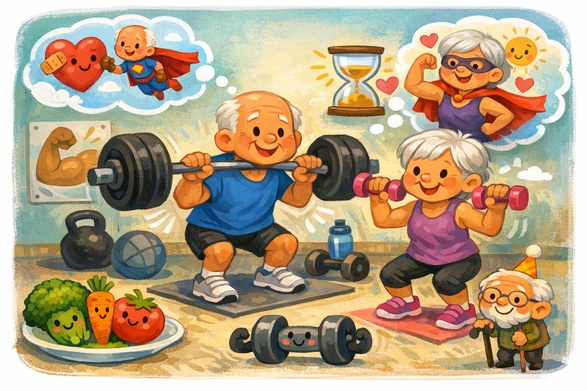
| tl;dr | Harvard Health Publishing summarizes a large long-term observational study suggesting that doing resistance/strength training regularly (along with aerobic activity) is associated with lower risk of death over ~30 years. It reports the biggest benefit with moderate amounts of strength training and encourages starting gradually (body-weight, bands, light dumbbells) while noting this is not personalized medical advice. | ||||
| deeper: | Content: The piece is a short “news brief” reporting results from a major cohort study (about 147k adults, followed up to ~30 years) and focuses on the association between strength training frequency and all-cause mortality, noting the strongest benefit at moderate levels and providing practical starter suggestions. Bias: The tone is health-promotional and leans toward encouraging strength training, but it largely sticks to cautious language (“linked,” “may,” “associated”) and does not make overt political or ideological claims. Potential bias comes from simplification and emphasis on benefits: it highlights the headline finding while giving limited space to caveats like confounding (healthier people may be more likely to exercise), measurement error (self-reported activity), changes in behavior over decades, and the fact that observational associations are not proof of causality. Quality: Above average for a public-facing health summary: it identifies the study type and scale, gives concrete numbers (e.g., ~13% lower mortality with ~90 min/week of strength training; ~45% lower risk with combined strength + aerobic activity), and includes author/reviewer credentials plus a medical disclaimer. Limitations: it provides few methodological details (how strength training was defined/updated, adjustment variables, effect sizes across subgroups), and it doesn’t clearly state potential harms/contraindications or the uncertainty bounds (confidence intervals), which would help readers interpret the magnitude and reliability of the findings. | ||||
media: | |||||
You made it to the bottom. Now dance!


owned and operated by: RPN Omnigalactic Insitutution as of: 2026/10/14: 07:16 in 0 ms
Enter Code
Login with Account